
Choosing a customer isn't a marketing decision
When leadership teams talk about growth, the conversation usually starts the same way.
"Should we go after enterprise?"
"What if we sold to schools?"
"Could we open a wholesale channel?"
On the surface, these sound like sales and marketing decisions. In reality, they're strategic decisions that influence almost every part of the business. The customer you choose determines how you acquire leads, how you position your company, how you sell, how you deliver your product or service, what capabilities you build internally, and ultimately how profitable the business becomes.
That's why I think most companies ask the wrong question.
Instead of asking, "Who should we build this business around?", they ask, "Who else can we sell to?"
Those questions sound similar, but they lead to very different businesses.
Why one product became multiple business models

I recently worked with a company that couldn't understand why revenue continued to grow while profitability remained flat. From the outside, the business looked healthy. The product had strong demand, customers were buying, and the leadership team was executing well. Yet every quarter felt more complicated than the one before.
When we mapped the business, the problem became obvious.
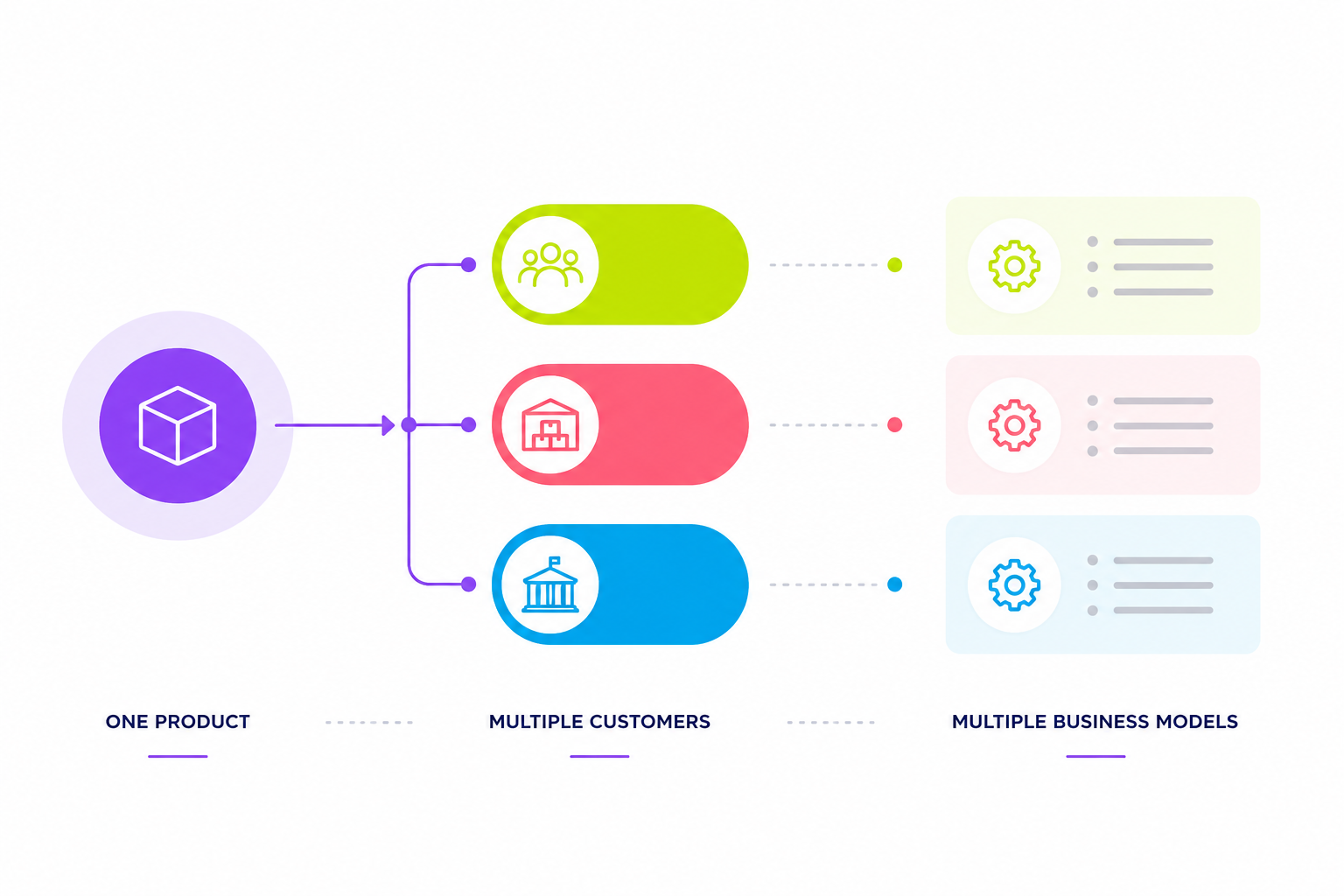
Although the company sold a single product, it wasn't operating a single business model. Over the years, it had gradually expanded into several different customer segments:
- Direct-to-consumer
- Wholesale
- Retail
- Schools
- Government organizations
Each decision made sense on its own. Each new segment represented another revenue opportunity. Together, however, they created a business that had become increasingly difficult to operate.
The team thought they were serving more customers.
In reality, they were managing multiple business models.
Why every customer segment changes the business
One of the most common objections I hear is:
"We're selling the exact same product. Why does it matter who buys it?"
Because while the product stays the same, almost everything surrounding the product changes.
Selling directly to consumers requires one acquisition strategy, one buying experience, and one customer journey. Selling wholesale introduces distributors, account management, different pricing structures, and long-term commercial relationships. Schools and government organizations introduce different procurement processes, longer buying cycles, additional stakeholders, and different expectations altogether.
The product may not change, but the business certainly does.
Every new customer segment typically requires its own:
- Marketing strategy
- Positioning
- Sales process
- Buying journey
- Customer experience
- Pricing model
- Operational processes
- Customer success approach
At some point, the leadership team is no longer optimizing one business model. It's trying to optimize several at the same time.
Why complexity isn't the real problem
Most founders recognize that serving multiple customer segments creates complexity. I agree—but I don't think complexity is the real cost.
The real cost is opportunity cost.
Every additional business model competes for the same finite resources. Leadership attention, marketing budget, operational systems, product development, hiring, and capital all become divided across competing priorities. As resources become fragmented, it becomes increasingly difficult to build excellence anywhere.
The consequences rarely appear overnight. Instead, they show up gradually.
You begin to notice that:
- Marketing becomes less focused because every audience needs different messaging.
- Sales becomes harder to standardize because every customer buys differently.
- Operations become increasingly customized as every segment requires exceptions.
- Product decisions become less clear because every customer wants something different.
None of these changes seem significant individually. Collectively, they create a business that feels heavier every year.
Instead of becoming exceptional at serving one customer exceptionally well, the company slowly becomes average at serving many.
When does expansion actually make sense?
This isn't an argument against expansion. Most successful companies eventually expand into adjacent customer segments, products, or markets. The question isn't whether you should expand. It's when.
The companies that expand successfully usually have three things in common:
- They have a repeatable and predictable customer acquisition engine.
- They have proven that their existing business model consistently generates attractive profits.
- They have operational systems that allow the business to run without the founders making every important decision.
Once those foundations exist, adding another customer segment becomes a strategic expansion.
Before then, it's usually another source of complexity competing for the same limited resources.
Sequence matters.
How we identify the Perfect Customer

This is exactly why Perfect Customer is one of the first decisions inside the Growth Decisions Canvas.
Before discussing marketing strategy, positioning, or growth initiatives, we first identify every meaningful customer segment the business currently serves. The objective isn't to find the segment generating the most revenue today. It's to identify the customer that deserves to become the center of the business.
To make that decision, we evaluate every customer segment using three filters:
1. Profitability
Which customer creates the healthiest economic engine?
We're not simply looking for revenue. We're looking for the segment that generates attractive margins without creating disproportionate operational complexity.
2. Long-term potential
Is this a market worth building around?
Some customer segments generate good short-term results but offer very little long-term opportunity. Others create a foundation that the company can continue expanding for years.
3. Unique fit
What makes your company uniquely positioned to win?
This isn't about being slightly better than competitors. It's about identifying the customers for whom your capabilities, experience, and strategic advantages create a meaningful competitive edge.
Once that decision becomes clear, many of the company's biggest decisions become dramatically easier. Marketing becomes more focused because the message is built around one customer. Sales become more repeatable because the buying journey is consistent. Operations become simpler because the team is solving the same problems repeatedly instead of constantly switching contexts.
Choosing a Perfect Customer doesn't just improve marketing.
It simplifies the business.
Reflection
Growth-stage companies rarely struggle because they lack opportunities.
More often, they struggle because they pursue too many opportunities before fully capitalizing on the one that's already working.
If you could only serve one customer segment for the next three years, which one would you choose?
More importantly, what would your business look like if every decision—from hiring to product development—was optimized around serving that customer exceptionally well?
.png)


Lorem ipsum dolor sit amet, consectetur adipiscing elit. Suspendisse varius enim in eros elementum tristique. Duis cursus, mi quis viverra ornare, eros dolor interdum nulla, ut commodo diam libero vitae erat. Aenean faucibus nibh et justo cursus id rutrum lorem imperdiet. Nunc ut sem vitae risus tristique posuere.
Leave a Comment
Your email address will not be published.